


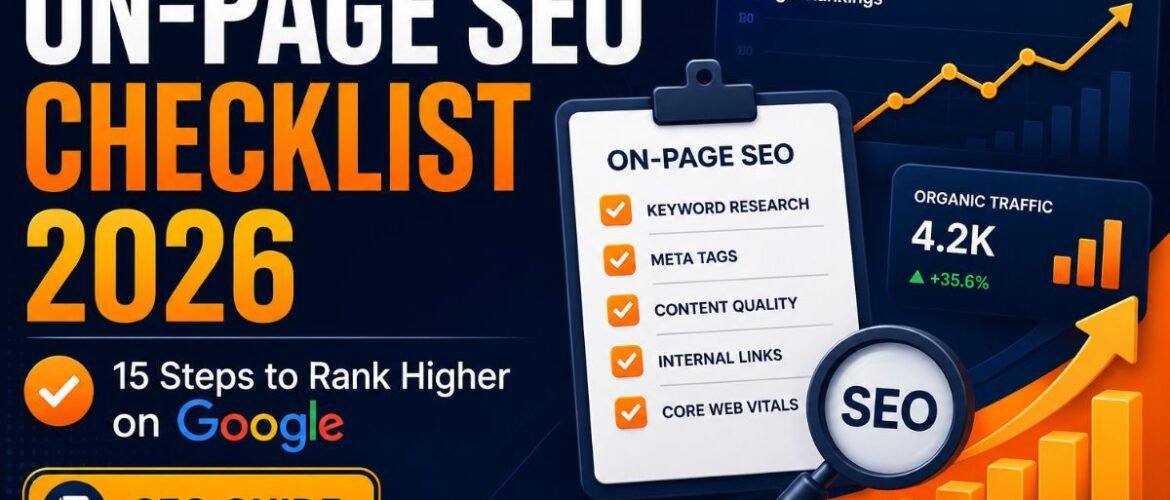
To get to higher Google rankings, optimization starts with on-page SEO. The best seo agency will tell you that this ultimate guide to on-page SEO will walk you through an exhaustive, step-by-step on-site SEO checklist, from title tags, meta information, and content structure, to Core Web Vitals and schema markup. Whether you’re a first-timer running an audit – or a pro looking to fine-tune your advanced SEO strategy – this on-page optimisation checklist will help you rank smarter, not harder, brought to you by Octaads Media.
What Is On-Page SEO? (And Why It Still Dominates Rankings in 2026)
On-page SEO, or on-site SEO as it is sometimes called, means all the actions you take to optimise a web page in order to make it easier for search engines to recognise the content and determine how relevant it is. Subsequently, on-page SEO is the only part that you have complete control over, whereas off-page SEO is all about backlinks and signals from other sites.
This control is what counts now more than ever. Google’s Helpful Content System performs a complete evaluation of pages by checking factors such as topical depth, user intent, expertise in the real world, etc. Pages that are thin and lacking in substance are rapidly becoming less important. On the other hand, those that are well-optimised and of high-quality keep winning the race.
Here is what strong on-page SEO delivers:
- Better crawlability: Search engines can read and index your pages efficiently
- Improved relevance signals: Pages match the exact intent behind user queries
- Higher click-through rates: Optimised titles and meta descriptions attract more clicks
- Reduced bounce rates: Structured, readable content keeps visitors engaged longer
- Stronger topical authority: Well-optimised pages reinforce your site’s expertise signals
Getting your on-page fundamentals right is the foundation of any serious SEO strategy. Let’s walk through every element you need to address.
The Complete On-Page SEO Checklist for 2026
1. Keyword Research and Search Intent Alignment
Every optimised page begins with just the right keyword, and the right answer to what that keyword seeker really wants. Be sure to ask yourself before you write a single word: Is this query informational, niche, commercial, or transactional? Google is looking for different content for each search intent.
On-Page SEO checklist items for keyword strategy:
- Define your main keyword and one or two closely related semantic variants
- Map the search intent: informational, commercial, or transactional
- Scout the top 5 ranking pages to study content format and depth
- Find your secondary words and LSI words from Google’s People Also Ask and related searches
- Cluster relevant keywords that could be covered on the same page
2. SEO Title Tag Optimisation
Your title tag is the key element through which your entire on-page SEO strategy is most clearly communicated to Google and the end user. It represents the very first thing Google and users see, and therefore your title tag plays a huge role in both the indexing ability of Google and users’ decision-making whether to click or not.
Best practices for title tag optimisation:
- Try to have it be no longer than 60 characters so it doesn’t get cut off in SERPs
- Put your main keyword as near the front as possible
- Make it stand out, add a power word, a number, or a value proposition
- Don’t stuff keywords; one excellent keyword placement is just enough
- Ensure the title reflects the actual content of the page
3. Meta Description Optimisation
It has been said that Google doesn’t consider meta descriptions for rankings directly. But they can greatly affect your click-through rate, which can lead to better rankings.
Meta description checklist:
Keep it between 140 and 160 characters
- Include your primary keyword naturally
- Write it like ad copy, give users a reason to click
- Summarize what the page offers, not just what the subject is
- Make sure meta descriptions are unique for each page
A good meta description should address the question that the reader is most likely to ask themselves: ‘What’s in it for me if I click this?’
4. H1 Tag and Heading Structure
Your H1 is the page’s main title, which appears to the users, and it should be your primary keyword. Each page requires just one H1. Besides it, your H2 and H3 headings develop the structural framework of your content.
Heading structure checklist:
- Use only one H1 per page, and add the main keyword
- Use H2s to identify major divisions; naturally incorporate secondary and LSI keywords
- Use H3s to split H2 sections into very manageable sub-points
- Make headings scannable, people often skim before deciding to read
- Do not use headings only for visual decorating.
Clearly structured headings directly influence featured snippets on Google. Having a simple and logical heading outline benefits Google in understanding your content and extracting answers for the People Also Ask section.
5. URL Structure and Slug Optimisation
Your URL is a ranking signal, a trust signal, and a user experience element – all at once.
URL optimisation checklist:
- Keep URLs short, clean, and descriptive
- Include the primary keyword in the slug
- Use hyphens to separate words – never underscores
- Avoid dates, session IDs, and unnecessary parameters
- Use lowercase letters only
For example: Good URL: yoursite.com/on-page-seo-checklist | Bad URL: yoursite.com/blog?p=2047&cat=SEO
6. Content Depth, Quality, and Topical Coverage
This is where most websites either win or lose in 2026. Google’s Helpful Content System specifically targets shallow, thin, or AI-padded content. Pages that win are those that genuinely answer the reader’s question with real depth.
Content quality checklist:
- Cover the primary topic comprehensively – do not leave obvious sub-questions unanswered
- Write at a reading level appropriate for your audience
- Use real examples, specific data, and actionable recommendations
- Avoid filler phrases and generic explanations
- Structure content with a clear beginning, middle, and conclusion
- Include original insights or perspectives where possible
A strong benchmark: After reading your page, a visitor should feel like they do not need to go back to Google. That is what helpful content actually means.
7. Keyword Placement and Density
Keyword placement is not about stuffing – it is about strategic positioning that tells Google your page is genuinely relevant for a topic.
Keyword placement checklist:
- Include the primary keyword in the first 100 words of body content
- Use the primary keyword in at least one H2 heading
- Distribute secondary and LSI keywords naturally throughout the body
- Avoid repeating the exact primary keyword phrase more than once every 150–200 words
- Use semantic variations and related terms freely – Google understands synonyms
A natural keyword density for a 3,000-word article is typically 0.5%–1.5% for the primary keyword. Above that, you risk over-optimisation penalties.
8. Image Optimisation
Images improve engagement – but unoptimised images hurt page speed and miss valuable SEO opportunities.
Image optimisation checklist:
- Compress images before uploading – use WebP format where possible
- Write descriptive alt text for every image – include keywords where relevant and natural
- Use descriptive file names (e.g., on-page-seo-checklist. webp, not image001.webp)
- Set explicit width and height attributes to prevent layout shifts
- Use lazy loading for images below the fold
Alt text serves two purposes: it helps visually impaired users understand images, and it gives Google additional context about your page content.
9. Internal Linking Strategy
Internal links distribute page authority across your site and help Google discover related content. They also guide visitors deeper into your funnel.
Internal linking checklist:
- Link to relevant, high-value pages using contextual anchor text
- Avoid generic anchor text like ‘click here’ – use descriptive, keyword-rich anchors
- Aim for 3–5 internal links per 1,000 words of content
- Link to pillar pages and cornerstone content to reinforce topical authority
- Audit internal links regularly for broken or redirected URLs
Performance marketers at Octaads Media typically see measurable improvements in crawl depth and page authority distribution within 60–90 days of implementing a structured internal linking strategy.
10. External Links and Citations
Linking out to authoritative, relevant external sources builds credibility. Google’s Quality Raters look for this as a trust signal.
External linking checklist:
- Link to reputable sources – established publications, academic studies, official documentation
- Open external links in a new tab to keep users on your page
- Use rel=nofollow for sponsored or affiliate links
- Avoid linking to competitors’ core product pages unnecessarily
- Review external links periodically – outdated or broken outbound links hurt credibility
11. Page Speed and Core Web Vitals
Technical performance is a direct Google ranking factor through Core Web Vitals. A beautifully written page that loads in 6 seconds will still underperform a faster competitor.
Page speed checklist:
- Aim for Largest Contentful Paint (LCP) under 2.5 seconds
- Keep Cumulative Layout Shift (CLS) below 0.1
- Target Interaction to Next Paint (INP) under 200ms
- Minimise render-blocking JavaScript and CSS
- Enable browser caching and use a CDN
- Use Google PageSpeed Insights and Lighthouse regularly
Core Web Vitals are a page-level signal – meaning each page on your site needs to pass independently.
12. Mobile Optimisation
Google indexes the mobile version of your site first. If your mobile experience is broken or frustrating, your rankings will reflect it.
Mobile optimisation checklist:
- Use responsive design – content should adapt cleanly to all screen sizes
- Ensure tap targets (buttons, links) are large enough for finger taps
- Avoid interstitials or pop-ups that cover content on mobile
- Test every page with Google’s Mobile-Friendly Test tool
- Check font sizes – minimum 16px for body text on mobile
13. Schema Markup and Structured Data
Schema markup does not directly boost rankings, but it enables rich results, which improve click-through rates significantly.
Schema checklist for on-page SEO:
- Add Article or BlogPosting schema to blog content
- Implement FAQ schema for pages with question-and-answer sections
- Use “HowTo” schema for step-by-step guides
- Add Breadcrumb schema to support site navigation signals
- Validate all schemas with Google’s Rich Results Test before publishing
The FAQ schema is particularly valuable – it can display your answers directly in the SERP, increasing visibility without requiring a higher ranking.
14. Content Freshness and Update Signals
Google tends to give higher ranks to content that is not only factually correct but also regularly updated, especially for those subject areas where things are constantly changing.
Content freshness checklist:
- At least once a year, go through and make updates to the pages bringing the most traffic
- Changing the release or last updated date is also necessary if a major change has been made
- Statistics, screenshots, or tools that are no longer valid have to be deleted or substituted
- If the information environment for a certain topic changes, add fresh parts accordingly
- Regularly ranking, checking, and noting down any drop can be considered as a hint for content updation
The Content SEO checklist 2026 is pretty much useless unless the data is in line with the latest best practices. Content that has been left untouched loses its rank little by little to new, fresh content.
15. On-Page SEO Audit: Putting It All Together
- Use a website crawling tool such as Screaming Frog or Sitebulb to discover technical problems.
- Look at where your keywords are put, make sure that the main keyword is present in all the essential places.
- Double-check heading structure, make sure there are no missing H1s, duplicate H1s, or broken hierarchies.
- Have a look at metadata, make sure title tags and meta descriptions are not only unique but also within the character limits.
- Check page speed, run Lighthouse both for mobile and desktop.
- Inspect internal links, make sure that relevant pages are linked to each other with the right anchor text.
- Confirm schema, verify that the structured data contains no errors.
- Measure content depth, look at your page, then at the top 3 ranking pages, and identify what you are missing.
Doing such an audit every three months ensures your pages remain competitive, as Google’s algorithm is ever-changing and your pages are always one step ahead of the competition.
On-Page SEO Comparison: Basic vs. Advanced Optimisation
The table below captures the critical difference between SEO that was sufficient in 2018 and SEO that competes effectively in 2026.
| SEO Element | Basic Approach | Advanced Approach |
| Title Tag | Includes primary keyword | Keyword-first, power word, <60 chars |
| Meta Description | Generic description | Benefit-driven, CTA-optimised |
| Content Length | 500–800 words | 2,500–4,500+ words with full topic coverage |
| Keyword Usage | Primary keyword only | Primary + secondary + LSI + semantic |
| Headings | H1 and some H2s | Strategic H1/H2/H3 hierarchy with keywords |
| Images | Basic alt text | Compressed, descriptive filenames, WebP, lazy load |
| Internal Links | 1–2 links per page | 3–5 contextual links per 1,000 words |
| Schema Markup | None | Article, FAQ, HowTo, Breadcrumb |
| Page Speed | Not actively monitored | Core Web Vitals tracked and optimised |
| Content Updates | Set and forget | Regular audits with freshness updates |
Frequently Asked Questions (FAQs)
A: On-page SEO refers to all optimisations made directly on your website pages – including title tags, content structure, keyword placement, and technical elements. It matters because it is how Google determines whether your page is relevant and valuable for a given search query.
A: Conduct a full on-page SEO audit at least quarterly for high-priority pages. For newer sites still building authority, monthly reviews of your top-performing pages can accelerate ranking gains significantly.
A: No single factor dominates – but content quality and search intent alignment consistently have the highest impact. A page that perfectly matches what users are looking for will outperform technically superior pages with misaligned content.
A: Length should match the topic’s complexity and what competitors are ranking with. For competitive keywords, 2,500–4,500 words is common. For simpler queries, 800–1,200 words may be sufficient. Prioritise depth over word count.
A: Keyword density as a strict metric is outdated, but natural, contextual keyword usage still matters. Aim for 0.5%–1.5% for your primary keyword and use semantic variations throughout. Over-optimisation can trigger Google penalties.
A: Google Search Console, Screaming Frog, Ahrefs, Semrush, Surfer SEO, and Lighthouse are among the most effective. Google’s free tools – PageSpeed Insights and Rich Results Test – are essential for Core Web Vitals and schema validation.
A: Yes, especially for low- to medium-competition keywords. Strong on-page SEO can rank pages without significant backlink profiles. For highly competitive queries, on-page optimisation amplifies the impact of your off-page efforts.
A: On-page SEO focuses on content and page-level optimisations – titles, headings, keywords, and structure. Technical SEO covers site-wide infrastructure such as crawlability, indexation, and server configurations. Both are necessary.
Your On-Page SEO Checklist Is Your Roadmap to Higher Rankings
On-page SEO is still one of the strongest digital marketing services moves that can be effectively leveraged and yield high returns. Our tasks would multiply if we do the work right, including one, each optimised page, besides strengthening your topical authority and enhancing crawability, will also open up internal linking that would be very helpful for your entire site. This checklist provides a comprehensive guide to reviewing, fine-tuning, and keeping your site pages running competitively, not only in 2026 but also in later years.
Octaads Media distinguishes campaigns that hardly grow from those that are consistently expanding thoroughly by sticking to the basics. Basic keyword targeting with great content, good technical deployment, and proper use of structured data are not fancy moves, they are the basics. Consider on-page SEO as continual upkeep rather than a single event.
Begin with your most visited pages, carefully carry out this checklist, and check back every 90 days. Multiple small, steady upgrades on various pages will cumulatively lead to major progress. However, if you wish to speed up the process, see how Octaads Media develops an SEO strategy for performance-driven companies.Disclaimer: The information in this article is intended for educational purposes only. SEO results vary based on website authority, industry competition, content quality, and algorithm changes. Strategies that deliver strong results in one context may produce different outcomes in another. Always test and adapt based on your own site’s data and performance metrics.
Last Updated on: July 27, 2026
Leave A Comment