


Running banner ads that convert customers by only 1.5% is like wasting money on fire. Good e-commerce goes beyond attractive web visuals- it’s a sales accelerator. You get customers flocking as naturally to a well-developed e-commerce site as water falls downwards. Build one with fast loading speed, mobile-friendly navigation, a simple and fast purchase process and you won’t even have time to check the sales numbers before they start coming in.
Watching your Meta ad budget burn while shoppers drop off before your page even loads is incredibly frustrating. Many startups fall into the “theme trap,” stacking plugins to fix basic site issues-only to slow things down further. A streamlined approach keeps visitors engaged and buying.
It turns out that starting a successful direct-to-consumer store is much more than just good photos and a beautiful color palette. It demands a completely frictionless buying journey where every pixel is working to drive sales. OctaAds Media – We build through a growth lens-making sure your storefront is built for paid media, technical SEO, and conversions before you launch.
Tech Stack Architecture: Choosing the Right Engine
Selecting an underlying technology is one of the key choices that you’re going to have to make. The moment you launch your ad campaigns and your business is on the brink, having selected the wrong framework will have you paying high maintenance fees or stuck within fixed templates.
| Platform | Best Suited For | Setup Time | Customization Flexibility | Monthly Operating Overhead |
| Shopify / Shopify Plus | Rapidly growing D2C brands | 3–5 Weeks | High (Liquid & Apps) | Predictable (SaaS Fee + Apps) |
| WooCommerce | Content-heavy & custom stores | 4–6 Weeks | Unlimited (Open Source) | Variable (Hosting + Plugin Security) |
| Headless (Next.js / Hydrogen) | Enterprise scale & custom UX | 8–12+ Weeks | Absolute Control | High (Dedicated Developer Team) |
Shopify vs. WooCommerce vs. Headless Commerce
Shopify remains the one of the best CMS for e-commerce website development if you value speed, reliability, and a pre-packed platform ecosystem. The system can easily take care of huge traffic surges during big sale events and thus your site will never crash even when an influencer’s viral post brings in huge traffic.
WooCommerce makes your work as a programmer or owner very hands-on since you have full control of the codebase and the database. This means you can do very deep customization in your business processes without you having to worry about a software subscription renewal.
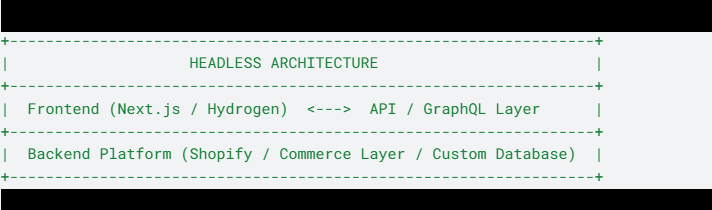
But if you are receiving huge order volumes from different parts of the world and your page loading time is not acceptable at all, Headless Commerce is a suitable architectural choice. Separating the frontend and the backend allows you the most extreme level of control on your website’s aesthetic design. Still, this freedom comes at a price as a dedicated development team is essential for keeping this set-up running.
Real-World TCO: The 3-Year Cost Breakdown
Looking solely at initial setup fees is a common trap. A cheap initial setup often hides long-term maintenance bloat.
| Expense Category | Year 1 (Build + Launch) | Year 2 (Growth & Maintenance) | Year 3 (Scale & Optimization) |
| Custom Theme Setup | $3,000 – $6,000 | $1,200 (App & Plugin Fees) | $1,500 (Updates & Tweaks) |
| Tailored D2C Engineering | $8,000 – $15,000 | $2,000 (Optimization) | $2,500 (Advanced Features) |
| Headless Build | $25,000+ | $6,000+ (Dev Ops Support) | $8,000+ (Custom Infrastructure) |
Catalog & Data Modeling: The Foundation Competitors Skip
A messy backend leads to a frustrating frontend experience. If your category structure isn’t mapped properly, search engine bots struggle to index your products, and shoppers get lost trying to find basic product variations.
[ Homepage ]
└── [ Parent Category: Apparel ]
└── [ Sub-Category: Men’s Outerwear ]
└── [ Product Page: Insulated Jacket ]
├── Metafields: Material, Fit Guide, Care Instructions
└── Schema Markup: Price, In-Stock Availability, Reviews
Structuring Your Product Taxonomy for Scale
Keep your navigation flat. No customer should ever have to click more than three times to go from the homepage to the specific product checkout. Group collections by topics that shoppers actually follow, not only on the basis of product type, but also considering use-cases, bundles, or best-selling items.
Utilizing Metafields and Schema for Dynamic Storefronts
Modern product data architecture and metafields provide the possibility to show detailed product specifications, ingredient lists, size charts, and care instructions without overloading the main editor.
When structured metacards are used together with Schema.org JSON-LD, they help search engines to show rich snippets like star ratings, real-time pricing, and stock availability right within the search results.
{
  "@context": "https://schema.org/",
  "@type": "Product",
  "name": "Performance D2C Jacket",
  "image": "https://example.com/jacket.jpg",
  "description": "Breathable, weather-resistant outerwear engineered for daily wear.",
  "offers": {
    "@type": "Offer",
    "priceCurrency": "USD",
    "price": "129.00",
    "availability": "https://schema.org/InStock"
  }
}
Mobile-First UX & Performance Engineering
Over 75% of your ad traffic visits your site on a smartphone screen, often using mobile data. If your desktop store looks stunning but your mobile store takes four seconds to load, you are losing money every single hour.
PERFORMANCE THRESHOLDS

[ Fast Load: < 1.8s ]  =========> High Ad Conversions & Low Bounce Rate

[ Slow Load: > 3.5s ]  =========> High Drop-offs & Wasted Ad Spend
Establishing a Strict Site Speed Budget
Your site needs to stick to a strict site speed budget for online stores. Every third-party script, analytics tag, or live-chat widget adds weight to your load time.
- Keep overall page weight under 1.5 MB on initial load.
- Limit JavaScript execution time to under 300ms.
- Target a Largest Contentful Paint (LCP) of under 1.8 seconds.
Mobile UX Mechanics That Drive Conversions
Designing for a mobile-first e-commerce store design means building for thumb navigation:
- Sticky Bottom-Bar: Keep an “Add to Cart” bar fixed at the bottom of the screen as users scroll through product descriptions.
- Simplified Image Swiping: Use native swipe gestures for product galleries instead of small thumbnail dots.
- Accordion Content Blocks: Collapse long shipping policies and product details into expandable accordions to reduce visual clutter.
Optimizing Checkout & Fixing Payment Friction
Cart abandonment is the biggest leak in any e-commerce funnel. You have spent money getting a shopper to your product page; losing them at the final step is a costly mistake.
[ Product Page ] ──> [ One-Click Cart Slide-Out ] ──> [ Express Checkout Options ] ──> [ Order Confirmation ]
Eliminating Cart Abandonment at Checkout
To drive e-commerce store conversion rate optimization, streamline every element of your checkout flow:
- Offer Guest Checkout: Never force a user to create an account before they place an order.
- Express Wallets: Enable Apple Pay, Google Pay, and Shop Pay at the top of the page so customers can purchase in two clicks.
- Upfront Pricing: Disclose shipping fees, taxes, and estimated delivery dates early to prevent sticker shock.
Solving Cash-on-Delivery (COD) & NDR Leakage
If you sell in markets where Cash-on-Delivery is popular, high Non-Delivery Report (NDR) rates can eat through your profits. Knowing how to optimize e-commerce checkout for COD comes down to smart risk management:
| Bottleneck | Root Cause | Automated Solution |
| Fake Orders | Impulse clicks with invalid details | Mandatory OTP verification via WhatsApp/SMS |
| Address Errors | Incomplete street names or pin codes | Auto-complete address APIs at checkout |
| Buyer Remorse | Long delivery windows | Automated shipping status updates & confirmation notifications |
Building a Marketing-Ready Storefront from Day One
A brilliant website is useless if your tracking pixel misses half of your sales data or your ad campaigns direct traffic to a generic, slow home page.
[ User Interaction ] ──> [ Browser Data + Server-Side Tracking ] ──> [ Meta / Google Ads engine ]
│
▼
[ Optimized Retargeting ]
Tracking Infrastructure & Server-Side Analytics
With modern browser privacy settings and ad blockers restricting client-side cookies, standard tracking pixels can miss up to 30% of your conversions.
A marketing-ready e-commerce website architecture includes GA4 Server-Side Tracking & Pixels and Meta Conversions API (CAPI). By routing conversion events directly from your server to the ad platform, you feed accurate data back into your ad campaigns, helping your ad algorithms find high-intent buyers more efficiently.
Landing Page Engineering for Paid Campaigns
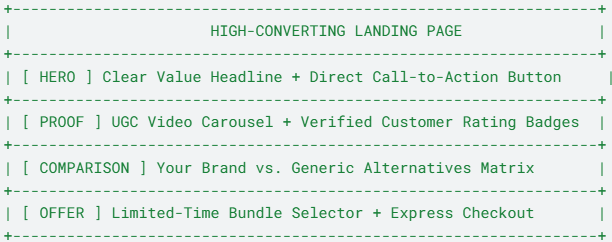
Sending paid traffic directly to your homepage is often a waste of ad spend. Instead, build modular, high-converting landing page templates that match your ad messaging:
- Hero Section: Clear headline, high-impact product video, and an immediate primary CTA.
- Social Proof Block: Verified customer reviews, press badges, and real user-generated content (UGC).
- Comparison Table: Show why your product beats traditional alternatives.
The Step-by-Step E-Commerce Development Process
Building a high-performing D2C storefront requires a clear, structured roadmap. Here is how we guide store builds from initial concept to launch:
[ Phase 1: Discover ] ──> [ Phase 2: Plan ] ──> [ Phase 3: Build ] ──> [ Phase 4: Launch ]
Phase 1: Discover & Audit
Our team will analyze your product catalog first, then map user personas and check historical ad metrics, and lastly, audit competitors. This will help us understand current user-journey pitfalls that drive low conversion rates and address them in the new store architecture.
Phase 2: Plan & Wireframe
By this phase, we have decided on tech stack choices, balanced platform costs, app needs, and maintenance requirements that were the main criteria while making selections. We will focus on making sketches of interfaces that will be user-centered and have user flow, custom metafield structure, and conversion path aspects considered.
Phase 3: Build & Integrate
The engineering team of our company will code your web store from scratch, which is going to be a great foundation for your business. We’ll connect your payment processing, synchronize the logistics and inventory systems, and set up the tracking infrastructure.
Phase 4: Launch & Quality Assurance
If everything checks out after multiple tests of quality assurance we will make your Shopify store go live. Before that, we will verify the site load speed using a speed testing tool, check out cart-related functionality by simulating various test orders, and also, server-side tracking events.
Beyond Development: Scaling Your D2C Growth Ecosystem
Launching your online store is just the beginning of the journey. Once your technical foundation is rock-solid, your growth depends on how effectively you drive qualified traffic and retain existing buyers.
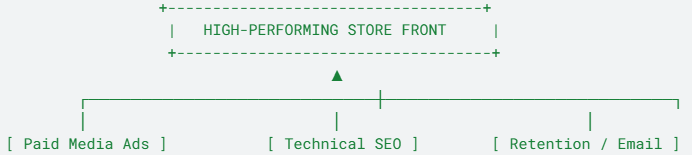
A well-optimized storefront amplifies every marketing channel:
- Paid Media: Faster load times and lower checkout friction raise conversion rates, dropping your acquisition costs (CAC) and raising your return on ad spend (ROAS).
- Organic Search: Clean code, fast load times, and structured product data improve search rankings, driving high-intent organic traffic.
- Customer Retention: A smooth post-purchase experience, combined with automated transactional communications, turns one-time shoppers into repeat buyers.
At OctaAds Media, we bridge the gap between technical web development and performance marketing. We ensure your website isn’t just an attractive digital catalog-it’s a sales engine designed to grow alongside your brand.
Frequently Asked Questions
Costs vary based on platform, custom design requirements, and integration complexity. A foundational Shopify build using custom components generally ranges from $3,000 to $7,000, while complex headless platforms or heavily customized enterprise builds can range from $15,000 to over $30,000.
Pre-made themes are fine for early-stage testing. However, as your sales volume grows, pre-made themes can slow down under the weight of multiple app integrations. Investing in custom design gives you better site speeds, cleaner brand identity, and complete control over your checkout funnel.
A custom platform build on Shopify or WooCommerce typically takes 4 to 6 weeks from initial discovery to final QA launch. More complex builds featuring headless architecture or custom integrations usually take 8 to 12 weeks.
Yes. At OctaAds Media, web development is integrated directly with performance marketing. We handle everything from store builds and redesigns to technical SEO, paid media campaigns, and ongoing conversion rate optimization (CRO) to keep your revenue scaling.
Ready to Build an E-Commerce Engine Made for Growth?
If your current online store fails to convert traffic, it is time to upgrade your digital strategy. Custom e-commerce website development ensures your D2C storefront delivers fast load times, seamless checkout experiences, and higher conversion rates tailored specifically to your audience.
Building a flexible, high-performing platform allows your brand to scale efficiently without tech limitations. Partnering with the right development experts transforms your storefront into a powerful, reliable engine designed for long-term growth and sustained revenue.
Ready to build a high-converting D2C brand? Connect with our strategy team at OctaAds Media today to discuss your project, evaluate your tech stack, and build a storefront designed to scale your brand.
Leave A Comment