


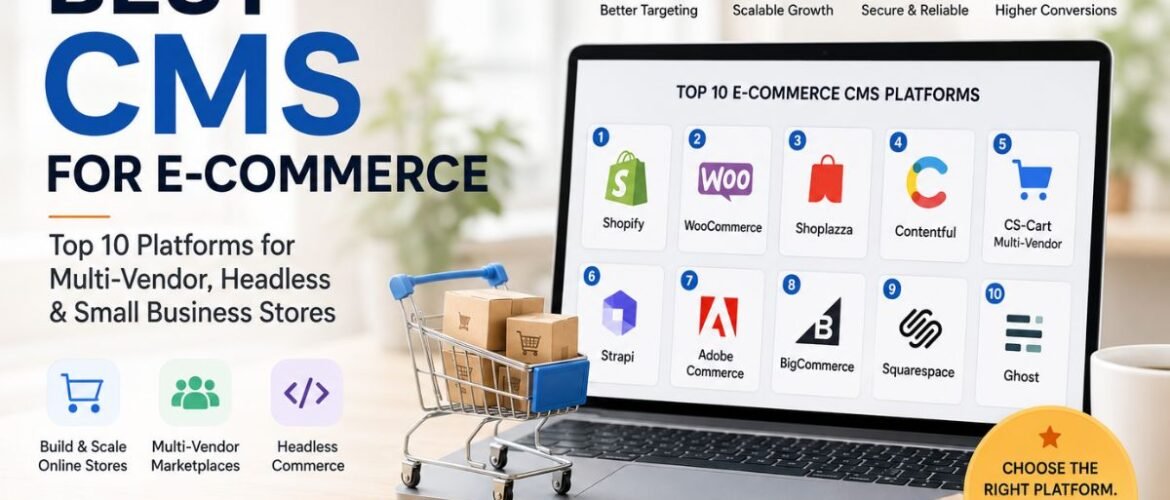
Best CMS for E-commerce in 2026
We evaluated 10 e-commerce CMS platforms across setup speed, real-world pricing, scalability, headless flexibility, multi-vendor support, and ecosystem strength — so you pick the right one the first time.
The best CMS for e-commerce is the platform that fits your business size and technical comfort — not the one with the most marketing pages. Shopify works for small stores, WooCommerce suits teams that prefer total control, and CS-Cart is purpose-built for marketplaces. This guide reviews the 10 top e-commerce CMS platforms for 2026 so you choose correctly the first time and avoid paying for features you’ll never use.
If you’re building an API-first storefront, you’ll find the best headless CMS for e-commerce here. If you’re launching a small store, the best CMS for small e-commerce business setups is covered. And if you’re building a marketplace, the best CMS for multi-vendor e-commerce is ranked too. Every platform comes with its real price tags, strengths, weaknesses, and ideal audience.
What to Look for in an E-commerce CMS
Run Every Platform Through This Checklist
- Total cost including transaction fees, apps, and hosting — not just the sticker price
- How much of the storefront you can customise without hiring a developer
- Whether the platform handles 10× your current order volume without a rebuild
- Built-in SEO controls — your CMS choice directly affects how well you rank
- Support quality when something breaks at 2 AM during a sale
- API and headless flexibility if you plan to go omnichannel
Shopify
Best CMS for Small E-commerce Business & ScalingIf you want to launch fast without touching a line of code, start here. Shopify remains the most reliable hosted e-commerce CMS in 2026, combining an intuitive drag-and-drop store builder with a massive app ecosystem of 8,000+ plugins. Out-of-the-box hosting, SSL, and PCI compliance mean you spend zero time on infrastructure. From first-time sellers to brands doing seven figures, Shopify scales without forcing a platform migration.
Strengths
- Extremely user-friendly drag-and-drop store builder
- Massive app ecosystem with seamless payment integration
- Excellent out-of-the-box hosting, security, and SSL
- Scales from solo sellers to Shopify Plus enterprise tier
Limitations
- Transaction fees apply unless you use Shopify Payments
- Advanced customisation requires learning proprietary Liquid language
- Monthly app costs can add up quickly for feature-heavy stores
WooCommerce
Best for Full Customisation & WordPress ControlIf you’d rather build on WordPress and keep full control over every pixel and function, WooCommerce fits you best. As a free, open-source plugin, it transforms any WordPress site into a fully functional store. The plugin and theme library is the largest in e-commerce, and SEO capabilities are unmatched thanks to native WordPress architecture. You own the code, the data, and the hosting — no vendor lock-in, ever.
Strengths
- 100% customisable — genuine open-source e-commerce CMS
- Massive library of plugins and themes via WordPress
- Strongest built-in SEO capabilities of any CMS platform
- No transaction fees — you choose your own payment gateway
Limitations
- Requires hands-on technical management (hosting, updates, backups)
- Can slow down significantly without proper optimisation
- Security responsibility falls entirely on you
Contentful
Best Headless CMS for E-commerceIf you’re shipping content across web, mobile apps, and connected devices, Contentful becomes your backend. As a pure API-first headless CMS, it decouples your content layer from the frontend presentation, giving developers absolute freedom to build storefronts in React, Next.js, or any framework. Pair it with Commercetools or Shopify Plus for transaction logic, and you get an enterprise-grade omnichannel commerce stack that scales globally.
Strengths
- Delivers content across web, mobile apps, and smart devices via APIs
- Gives developers absolute freedom over frontend presentation
- Highly scalable framework ideal for enterprise operations
- Rich content modelling with reusable structured content types
Limitations
- Requires separate e-commerce backend (Commercetools or Shopify Plus)
- Demands significant developer resources to build and maintain
- Not a fit for non-technical teams without dev support
BigCommerce
Best Hybrid Headless & Native CMSIf you want headless flexibility without giving up native features, BigCommerce balances both. It ships with more built-in commerce features than any competing SaaS platform — product rules, faceted search, multi-storefront, and B2B price lists all come standard without plugins. Zero transaction fees across all plans is a genuine differentiator, and its headless-ready APIs let you pair the backend with any frontend framework when you’re ready to go custom.
Strengths
- Outstanding native features that reduce the need for paid plugins
- Excellent headless-ready integration out of the box
- Zero transaction fees across all standard plans
- Strong multi-storefront and B2B capabilities built in
Limitations
- Annual sales thresholds auto-bump you to expensive tiers
- Theme editing dashboard feels clunky for beginners
- Smaller app marketplace compared to Shopify
Shoplazza
Best Lightweight CMS for E-commerceIf page speed matters more to you than a huge app store, Shoplazza delivers. Its lightweight code structure is optimised for fast page loads — a critical ranking factor that directly impacts conversion rates. Built-in cross-border and multi-currency selling tools make it particularly strong for global DTC brands. The intuitive dashboard requires zero coding knowledge, and at $28/month it undercuts Shopify’s base tier while matching its core feature set.
Strengths
- Highly optimised lightweight code for fast page speeds
- Excellent built-in cross-border and multi-currency tools
- Intuitive dashboard that requires zero coding knowledge
- Lower starting price than Shopify with similar core features
Limitations
- Smaller third-party app ecosystem compared to Shopify
- Advanced customisation limited on lower tiers
- Less community documentation and tutorials available
Strapi
Best Open-Source Headless CMS for DevelopersIf you have developers on hand and want to self-host everything, Strapi is the headless CMS they’ll actually enjoy working with. It’s 100% JavaScript-based, fully customisable, and the self-hosted architecture gives you total control over data security and compliance. Its lightweight API footprint guarantees rapid content rendering, and the admin panel is one of the most intuitive in the headless space. Connect it to Snipcart or Medusa for commerce logic.
Strengths
- 100% JavaScript-based, fully customisable, developer-friendly
- Self-hosted gives total control over data and security
- Lightweight API footprint for rapid content rendering
- Large open-source community with active plugin development
Limitations
- Requires technical expertise to deploy and configure
- Lacks native commerce logic — needs external shopping cart
- Self-hosting means managing your own server infrastructure
CS-Cart Multi-Vendor
Best CMS for Multi-Vendor E-commerceIf you’re building a marketplace with multiple sellers, CS-Cart was built for exactly that. Its out-of-the-box vendor management tools include individual storefronts, automated payout systems, vendor shipping calculations, and commission structures — all without plugins. The lifetime licence model (~$1,450 one-time) means no recurring SaaS fees eating into your marketplace margins.
Strengths
- Robust vendor management with individual storefronts
- Advanced automated payout and shipping calculations
- Purpose-built multi-vendor marketplace software
- One-time licence fee — no recurring SaaS costs
Limitations
- Steep learning curve for administrative users
- Significant upfront investment compared to SaaS
- Smaller community and fewer third-party add-ons
Squarespace
Best Visual CMS for Small E-commerce BusinessIf design matters to you as much as function, Squarespace delivers the most beautiful templates in e-commerce. Every theme is mobile-responsive and polished to a level that would cost thousands from a custom designer. Built-in scheduling, email marketing, and social tools are tied directly into the store, making it a genuine all-in-one for solopreneurs and small boutique brands that sell fewer than 500 SKUs.
Strengths
- Industry-leading, beautiful design templates out of the box
- Incredibly easy to manage for solopreneurs and boutiques
- Built-in scheduling, email, and marketing tools
- Excellent for portfolio-style stores and visual brands
Limitations
- Limited payment gateway integrations
- Not built for large inventories or multi-vendor structures
- E-commerce features locked behind higher-tier plans
Adobe Commerce
Best Enterprise Multi-Vendor E-commerce CMSIf you’re already running enterprise-level volume, Adobe Commerce (formerly Magento) is where you’ll likely end up. Its scalability is unrivalled — processing massive order volumes with complex B2B and multi-vendor setups that would break lighter platforms. Deep AI-driven personalisation, Adobe Sensei analytics, and native integrations with the full Adobe Experience Cloud give it a data advantage no competitor matches.
Strengths
- Unrivalled scalability for massive order volumes
- Powerful built-in B2B and multi-vendor capabilities
- Deep AI-driven personalisation and customer analytics
- Full Adobe Experience Cloud integration
Limitations
- Prohibitively expensive for small and mid-sized operations
- Requires specialised, certified developers to maintain
- Complex setup and long implementation timelines
Ghost
Best Content-First Commerce CMSIf your business leans on content and subscriptions more than physical inventory, Ghost is built for exactly that model. Its ultra-lightweight framework delivers some of the fastest page load times in the CMS space, and native support for paid memberships and subscriptions makes it ideal for creators, publishers, and digital product sellers. The distraction-free blogging interface is tailored for SEO, and at $9/month for hosted plans, it’s the most cost-effective content-commerce hybrid available.
Strengths
- Ultra-lightweight with fastest page loads in the CMS space
- Excellent native subscriptions and paid memberships
- Distraction-free, SEO-focused blogging interface
- Most affordable option for content-led commerce
Limitations
- Requires custom code integrations (like Snipcart) for physical products
- Not suited for traditional inventory-heavy retail stores
- Very limited theme and plugin ecosystem
Quick Comparison
All 10 platforms at a glance — compare pricing, positioning, and key capabilities.
| # | Platform | Starting From | Best For | Key Feature | Rating |
|---|---|---|---|---|---|
| 1 | Shopify | $39/mo | Small Biz & Scaling | Drag-and-drop builder | 4.8 |
| 2 | WooCommerce | Free (plugin) | Full Customisation | Open-source WordPress | 4.6 |
| 3 | Contentful | Free–$300/mo | Headless Commerce | API-first omnichannel | 4.7 |
| 4 | BigCommerce | $39/mo | Hybrid Headless | Zero transaction fees | 4.6 |
| 5 | Shoplazza | $28/mo | Lightweight & Fast | Multi-currency tools | 4.5 |
| 6 | Strapi | Free–$29/mo | Developer Headless | Self-hosted JS API | 4.5 |
| 7 | CS-Cart | ~$1,450 (lifetime) | Multi-Vendor | Vendor payout system | 4.4 |
| 8 | Squarespace | $23/mo | Design-First Stores | Visual templates | 4.4 |
| 9 | Adobe Commerce | ~$22,000/yr | Enterprise Multi-Vendor | AI personalisation | 4.3 |
| 10 | Ghost | Free–$9/mo | Content-First | Native subscriptions | 4.2 |
Which CMS Is Best for E-commerce? Our Final Verdict
There’s no single best CMS for e-commerce that works for everyone. The right choice depends on your budget, technical comfort, and where you expect your store to be in two years — not just where you stand today.
Whatever e-commerce CMS you choose, think of it as infrastructure, not decoration. Your platform should recede into the background while your products, pricing, and content do the heavy lifting of converting visitors into customers.
How We Ranked These Platforms
Setup Speed
How fast you can go from signup to live store — measured in hours, not marketing claims.
Pricing Transparency
Whether the pricing page tells the truth — hidden fees, app costs, and transaction charges included.
Scalability
How well the platform handles 10× your current volume without needing a full migration.
API & Headless Flexibility
How well the platform supports API-first architecture and headless commerce implementations.
Multi-Vendor Support
Whether the platform natively supports marketplace features — vendor dashboards, payouts, and commissions.
Ecosystem Strength
App stores, plugin libraries, theme variety, community size, and third-party integrations.
Frequently Asked Questions
This article is for informational purposes only and does not constitute a formal recommendation or endorsement of any single platform. Pricing, features, and ratings are accurate as of publication but may change. Results, costs, and suitability vary depending on business size, technical resources, and regional factors — always verify current details directly with each provider before making a purchasing decision.
Last Updated on: August 5, 2026
Leave A Comment