


Imagine you are running paid ads, your budget is draining fast, clicks are pouring in, and then you check your dashboard with zero conversions. Thousands of advertisers burn through budgets every month simply because they picked the wrong pricing model. Understanding what is CPA and how it relates to CPL, CPI, and CPS is the single most practical step you can take before spending another rupee on performance marketing.
Choosing the right pricing model in digital advertising and affiliate marketing matters because it can generate massive ROI or completely drain your budget into a black hole. If you are a beginner or an advertiser looking to scale, understanding what is CPA, what is CPL, what is CPI, and what is CPS is the first step toward mastery. Knowing when to use each is the difference between a campaign that quietly compounds returns and one that silently drains your budget. Businesses that invest in professional Digital Marketing Services often use performance models like CPA, CPL, and CPS to ensure every marketing dollar delivers measurable results.
This guide breaks down what is CPA as an umbrella concept, then goes deep into CPL, CPI, and CPS individually to find out how they work, who uses them, and how to decide which one belongs in your next campaign.
Quick Summary: Performance Models at a Glance
| Model | Full Form | Best For | Risk Level (Advertiser) |
| CPA | Cost Per Action | Conversions/Trials | Very Low |
| CPL | Cost Per Lead | Finance, Insurance, B2B SaaS | Low |
| CPI | Cost Per Install | Mobile Apps/Gaming | Moderate |
| CPS | Cost Per Sale | E-commerce, Retail | Zero |
What is CPA in Affiliate Marketing?
CPA stands for Cost Per Action, and it is one of the most widely used pricing models in digital advertising and affiliate marketing. At its core, what is CPA comes down to one principle: the advertiser defines an action, and they pay only when a user completes it.
The Core Definition of What is CPA
Unlike the CPM (Cost Per Mille/1,000 impressions) model, where you pay for views regardless of interest, CPA ensures that every dollar spent is tied to a result. But “action” is a broad term. Types of Actions in CPA:
- Filling out a multi-page registration form.
- Signing up for a 7-day free trial (often requiring a credit card).
- Subscribing to a premium newsletter.
- Booking a consultation.
The Advertiser’s View: Shifting the Risk
Why do businesses love the CPA model? It’s simple: risk management. CPA flips the traditional risk dynamic. In a CPM or CPC model, the advertiser absorbs all the risk — they pay regardless of whether the traffic converts. Under CPA, the affiliate takes on that burden. The affiliate invests time, and media spend driving traffic; the advertiser only pays if that traffic performs.

Real-World Example: Consider a major credit card company. They do not care about clicks from curious browsers. They care about submitted applications. So they run a CPA campaign, affiliates promote the card, drive traffic to the application page, and get paid only when a user fills out and submits the form. Zero applications, zero spend. This is the perfect embodiment of what is CPA.
What is CPL in Affiliate Marketing? (The Lead Generation Model)
If CPA is the “hard” conversion, then what is CPL? It is the “soft” conversion. CPL stands for Cost Per Lead. While some people use the terms interchangeably, there is a distinct difference between CPA and CPL that every marketer needs to know.
What is CPL in Affiliate Marketing?
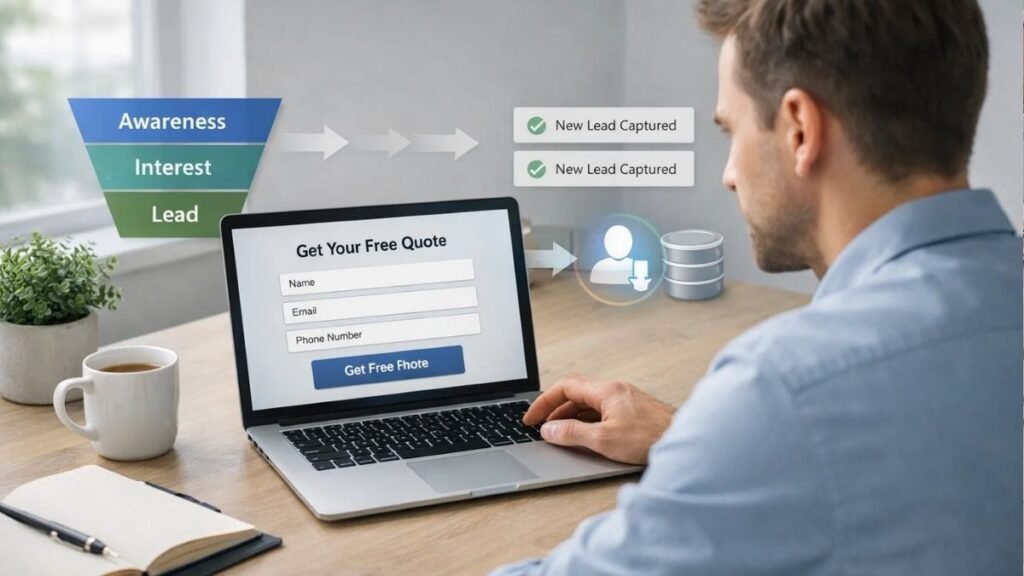
In affiliate marketing, with the CPL model, the goal is not an immediate sale or a complex registration. Instead, the focus is on gathering information, usually a name, email address, and phone number. This is the primary engine for “Top of the Funnel” marketing.
The Concept: Soft Conversions vs. Hard Sales
In a CPL vs CPA comparison, CPL is considered a “soft” conversion because the user isn’t committing to a purchase yet. They are simply raising their hand and saying, “I’m interested.” This makes it much easier for affiliates to drive conversions, though the payouts are typically lower than standard CPA offers.
Top Industries for CPL
You will see what is CPL used most frequently in industries with high customer lifetime value and long sales cycles:
- Education: Paying for students to request information about a degree program.
- Insurance: Getting users to request a free quote.
- B2B SaaS: Signing up for a demo of a software product.
- Finance: Inquiries for personal loans or debt consolidation.
Example Campaign: An eco-friendly energy company wants to find homeowners interested in solar panels. They pay an affiliate $15 for every homeowner who provides their zip code and phone number. The affiliate wins because it’s a simple form, and the brand wins because they now have a list of “warm” leads for their sales team to call.
What is CPI in Affiliate Marketing? (The Mobile Growth Engine)
If you have ever seen an ad for a mobile game on Instagram and clicked “Install,” you have participated in the what is CPI model. CPI stands for Cost Per Install.
What is CPI in Affiliate Marketing?
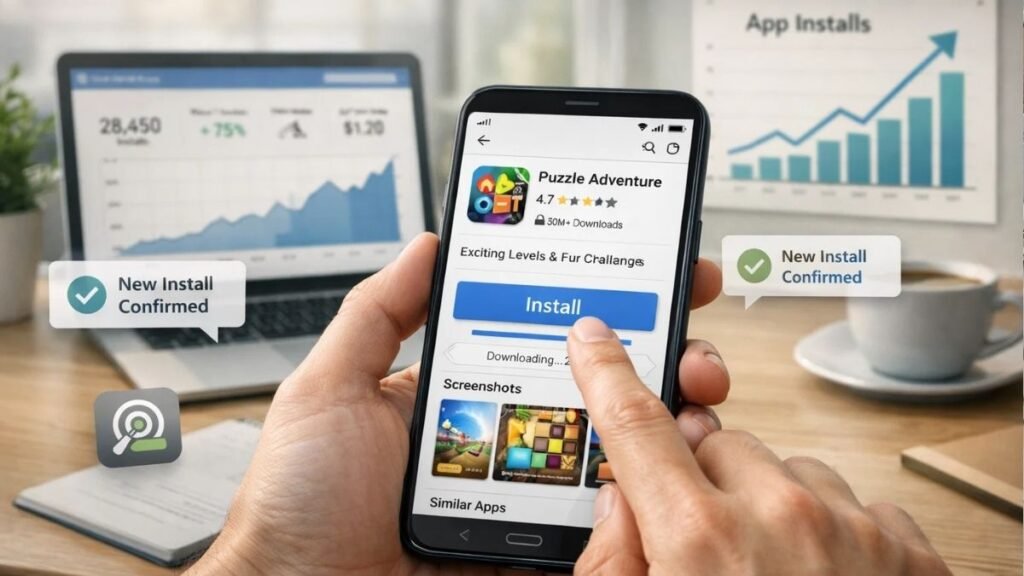
CPI (Cost Per Install) is the dominant pricing model in mobile app marketing. If you are looking at what is CPI in affiliate marketing, the answer is simple in concept: an app developer pays a fixed amount every time a user installs their app as a result of an affiliate’s promotional activity. But the mechanics running underneath it are more involved.
The Tech Angle: How it Works
Unlike a simple web form, CPI requires sophisticated tracking. Advertisers use SDKs (Software Development Kits) from companies like AppsFlyer or Adjust to verify that the install was real and not generated by a bot. This is where the CPI vs CPA debate often happens; while CPI pays for the install, many developers are now asking for “CPA” within the app—paying only if the user makes an in-app purchase.
Benefits for Developers
Mobile gaming is the largest single vertical in CPI. Hypercasual game developers particularly depend on it. High install volume is what feeds the algorithm signals that push apps up the store (Apple App Store or Google Play Store) rankings, which then drives organic discovery. It is a flywheel, and CPI spend is what starts the wheel turning.
E-commerce apps use CPI ahead of peak shopping seasons to build their active user base before promotional periods hit. FinTech apps — digital wallets, investment platforms, lending apps — use CPI to reach scale quickly because user growth is often a core metric for their own fundraising and regulatory milestones.
The developer benefit here is the speed of feedback. Install attribution happens in near real-time, which means campaign optimisation cycles are tight. A media buyer running CPI can see within hours whether a creative or placement is performing, adjust the bid or swap the asset, and see the impact the same day. That kind of speed is hard to find in CPL or CPS environments.
What is CPS in Affiliate Marketing? (The E-commerce Standard)
While we’ve discussed leads and installs, now the question comes to what is CPS in affiliate marketing? It is the pricing model that built the modern internet. CPS stands for Cost Per Sale.
The E-commerce Powerhouse
In the CPS model, the affiliate receives a commission only after a customer makes a verified purchase. This is the foundation of the Amazon Associates program and almost every fashion or retail affiliate program you see today.
Why E-commerce Brands Prefer CPS?
For a brand, CPS is a dream come true. It is 100% ROI-driven. If you sell a pair of shoes for $100 and pay the affiliate a 10% commission ($10), you are guaranteed a $90 gross sale before other costs. There is zero risk of paying for “bad traffic.”

The Affiliate’s Challenge
The downside? The barrier to entry is high. CPS in affiliate marketing demands traffic that is already close to buying. In CPS, the affiliate has to do all the heavy lifting—finding the right audience, building trust, and convincing them to spend their hard-earned money. It requires high-intent traffic, usually through SEO content, review sites, comparison platforms, or a dedicated audience built over months or years. Newer affiliates trying to make CPS work without that foundation will find it slow going.
Comparison: CPL vs CPA vs CPI vs CPS
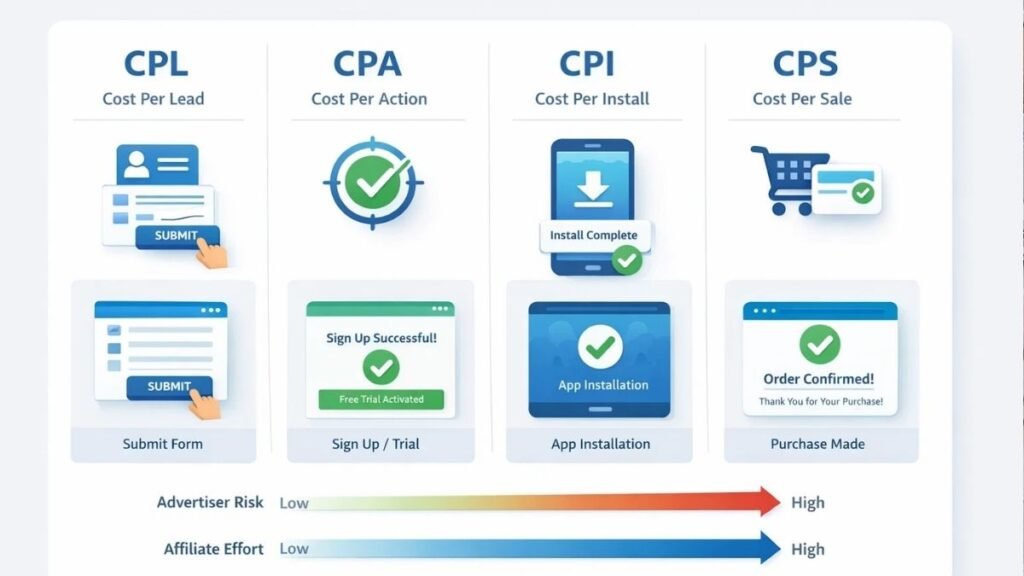
The clearest way to see what separates these models is to look at where the risk sits — and who bears it.
| Model | Advertiser Risk | Affiliate Risk | Conversion Difficulty | Typical Payout Style |
| CPA | Low | High | Medium | Fixed fee per action |
| CPL | Medium | Medium | Low to Medium | Fixed fee per lead |
| CPI | Low | high | Low (mobile users) | Fixed fee per install |
| CPS | Very low | Very high | High | % of sale value |
The Logic of Risk vs. Reward
- Advertiser Risk: CPS has the lowest risk (you only pay when you get paid). CPL has the highest risk (you might pay for a lead that never picks up the phone).
- Affiliate Reward: CPS and CPA usually offer the highest payouts (sometimes hundreds of dollars per action). CPL and CPI offer lower payouts but higher volume because the user doesn’t have to pay anything.
In the cpl vs cpa battle, affiliates often choose CPL when they have high-volume traffic that isn’t ready to buy yet. Advertisers move toward CPA when they want to ensure they are getting high-quality users who are ready to commit.
Choosing Your Strategy: Which Model is Best?
There is no “one size fits all” in performance marketing. Your choice depends on your role and your goals.
For Advertisers.
The honest answer is that the right model depends on what your sales process looks like. If you have a strong internal sales team that can close warm leads, CPL makes sense. If you are running a mobile product and need user volume fast, CPI is the only model worth considering at scale. If you run an e-commerce store and want zero-risk affiliate partnerships, CPS is the obvious choice. If you have a limited budget, start with CPS or CPA.
For Beginners
If you are a new affiliate, learning what is CPL in affiliate marketing is often the easiest entry point. Getting someone to enter an email address is far easier than getting them to buy a $500 software subscription. It allows you to learn the ropes of traffic generation without the frustration of low conversion rates. Choosing the best affiliate program is the foundation of success, since high-converting offers and reliable tracking directly impact your CPA earnings.
For High-Volume Affiliates
If you have a massive audience on social media or a popular mobile site, look into what is CPI in affiliate marketing. The friction is low, the “install” is a quick action, and you can generate thousands of conversions a day if the app is trending. Real-time attribution, fast optimisation cycles, and clear cost-per-install economics make it possible to run large campaigns efficiently.
Conclusion
Performance marketing’s greatest strength is its flexibility. Understanding what is CPA as an umbrella concept helps you navigate the more specific models beneath it. Use CPL when you need qualified leads and can handle a softer conversion. Use CPI when you are scaling a mobile app and need fast, measurable installs. Learn what is CPS when you want a fully risk-free affiliate programme where commissions only flow on completed revenue.
The future of performance marketing is moving toward even greater measurement precision — incrementality testing, first-party data attribution, and AI-driven bid optimization are reshaping how CPA models are priced and validated. But the underlying logic remains constant: pay for outcomes, not promises. Whichever model you choose, that principle is your foundation.
FAQs
The difference between cpa and cpl is the depth of the funnel. CPL (Cost Per Lead) usually only requires contact information, while CPA (Cost Per Action) often requires a more significant commitment, such as a trial signup or a completed application.
In the cpi vs cpa debate for gaming, it depends on your goal. CPI is better for getting a high volume of users to climb the app store charts. CPA is better if you only want to pay for “whales”—users who actually make in-game purchases.
CPS (Cost Per Sale) is zero risk for advertisers because the payout to the affiliate is only triggered after the customer’s payment is processed and verified. If the customer doesn’t buy, the advertiser pays nothing.
To start with CPL in affiliate marketing, join a reputable affiliate network (like MaxBounty or CJ Affiliate) and search for “Lead Gen” offers in niches like insurance, home improvement, or finance.
CPA (Cost Per Action) is a pricing model where advertisers pay only when a user completes a defined action — like filling out a form, registering an account, or signing up for a trial. No action, no payment.
Effectively, yes. CPS (Cost Per Sale) means the affiliate earns a percentage of every verified purchase they drive. That percentage-of-revenue structure is what most people mean when they talk about revenue share in affiliate marketing.
CPL tends to be the most accessible for beginners because the conversion action is less demanding than a sale. Users are more willing to fill in a form than hand over payment details, which means higher conversion rates and faster feedback on what is working with your traffic.
The main practical difference is environment and tracking. CPI is built specifically for mobile, using SDK-based device-level attribution. CPA is a broader model that runs across web and mobile using various tracking methods — pixels, postback URLs, cookies. If you are not running a mobile app campaign, CPA covers your use case; if you are, CPI is the standard.
Last Updated on: February 23, 2026
Leave A Comment