


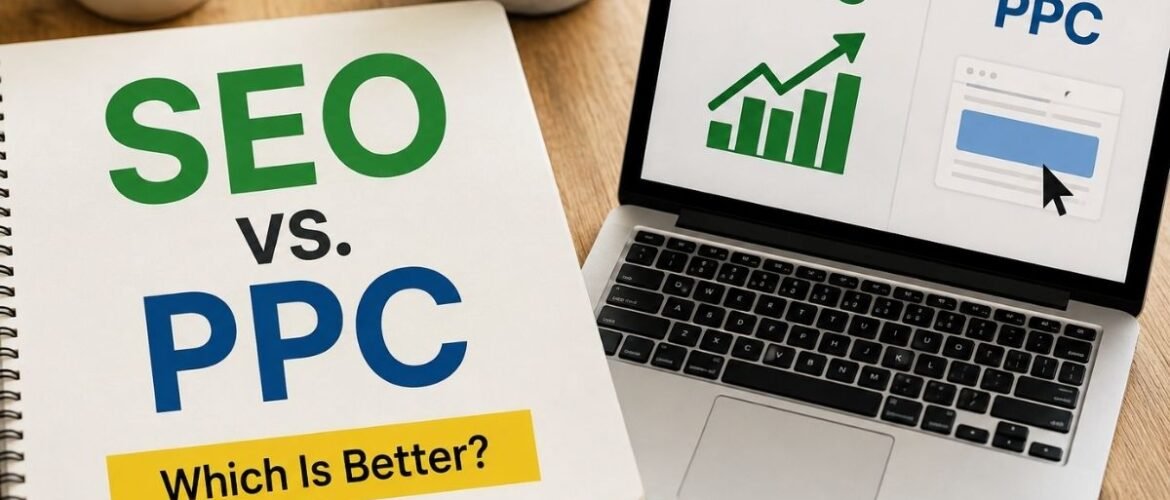
SEO vs. PPC Marketing: Which Is Better for Your Business?
SEO and PPC are the two pillars of search visibility – one built on organic rankings, the other on paid ads. Both work. They’re just built for different jobs, and picking the wrong one for the moment costs you time and money.
SEOOrganic, compounding, free clicks
PPCPaid, instant, pay-per-click
Google shows both on the same page for a reason – organic listings and sponsored ads serve different searcher intents. Any honest marketing strategy starts with understanding what each actually does. At OctaAds Media, this exact question comes up in nearly every client conversation, because organic and paid search rarely compete for the same job – they complement each other.
What Is SEO and PPC?
SEO – Search Engine Optimization
A strategy of improving your website’s content and quality so it appears naturally in search results, without paying for the click. It builds an authoritative, durable presence that draws free, precisely targeted traffic over time.
PPC – Pay-Per-Click
Paid advertising where you pay the search engine each time your ad gets a click, typically via Google Ads. It buys immediate visibility for a set of targeted keywords, delivering qualified traffic right away.
One relies on long-term growth through natural search. The other is a quick win you can switch on in minutes.
How They Show Up on the Same Results Page
Both formats appear on the same page, often for the exact same query – that’s not a coincidence. Different searchers want different things: someone comparing options might click an ad, someone still researching might scroll straight past ads to the organic listing. Neither format buys the other – a bigger ad budget won’t move your rankings, and a great blog post won’t land in the paid slots.
What Is the Actual Difference?
It comes down to how you pay, how fast you see results, and how long those results last:
| Factor | SEO | PPC |
|---|---|---|
| Cost structure | Upfront investment in content, technical fixes, tools – no per-visitor cost | You pay per click, whether or not it converts |
| Time to results | Weeks to months, longer for competitive keywords | Traffic within hours of launch |
| Traffic sustainability | Keeps sending traffic long after publishing | Stops the moment you pause the campaign |
| Control | Google decides ranking based on relevance and authority signals you can influence, not control | You control exactly which keywords and audiences you target, instantly |
| Scalability | Scales with content, backlinks and time | Scales with budget |
Not one being “better” – two different tools built for different jobs. It also shifts with searcher intent: someone typing a broad, informational question is usually still learning, and organic content tends to win their trust. Someone typing a specific product name with clear buying intent is often ready to click whatever answers them fastest – exactly where PPC does its best work.
SEO vs Paid Search: Side by Side
Paid search sits at the top, clearly labeled, competing purely on bid and relevance. Organic listings sit below, competing on rankings built over months of consistent optimization.
Google Ads runs on an auction – you bid on keywords, set a daily budget, and Google scores your ad on relevance and landing page quality before deciding where it appears. It’s fast, but it’s also a treadmill: stop paying, and your paid search visibility disappears instantly. Organic listings don’t work that way – once a page ranks well, it can keep pulling traffic for months or years with only occasional updates. That’s the trade-off at the heart of SEO vs paid search: speed versus staying power.
Which Is Better for Your Business?
It depends entirely on what you’re trying to achieve right now – and frankly, most growing businesses need both at different points in their journey.
When SEO Is the Better Choice
- You’re playing the long game and want traffic that compounds over time
- Your business runs on content – guides, comparisons, reviews
- Your ad budget is tight, but you have time to invest in content
- You’re targeting broad, informational searches
When PPC Is the Better Choice
- You need traffic starting this week, not next quarter
- You’re launching a new product or running a time-sensitive offer
- You’re targeting highly specific, high-intent commercial searches
- You need clean, measurable numbers tied to every rupee spent
Many marketers at OctaAds Media treat this less as an either-or question and more as a sequencing question – which channel goes first, and which one supports it. If your site has almost no organic visibility yet, PPC can carry you while SEO builds up in the background. If you already rank reasonably well, doubling down on content usually stretches your budget further than another ad campaign would.
How SEO and PPC Work Together
The smartest strategies don’t pick a side – they use each channel for what it’s genuinely good at. Run a PPC campaign first, and you’ll learn which keywords actually convert, not just which ones get clicks. Feed that insight back into your organic content plan, and you stop guessing what to write about next.
Appearing in both the paid and organic listings for the same search term makes your brand look bigger. Searchers see your name twice on one page – once as an ad, once as a genuine, earned result – and that repetition builds a real kind of trust. It’s a small thing, but it consistently improves click-through rate across both listings.
Most growing businesses get more value treating SEO and PPC as one connected search strategy rather than competing budgets.
SEO vs PPC for Different Business Types
E-commerce
PPC for the immediate seasonal sales window, paired with SEO on category and product pages that keep earning traffic year-round.
Local Business
Clinics, salons, service providers usually get faster wins from local search visibility and location-specific pages than broad national keywords.
B2B, Long Sales Cycle
Lean on SEO for educational, top-of-funnel content; reserve PPC budget for a handful of high-value, bottom-funnel search terms.
Startups
Often start with a small PPC push to validate demand, then shift spend toward SEO once they know what’s actually working.
Common Mistakes to Avoid
- Treating SEO as a one-time project – publishing a few blogs, waiting, and wondering why nothing changed. SEO is ongoing work, not a checklist you finish once.
- Running PPC without conversion tracking – you end up optimizing for clicks, not actual customers.
- Targeting the wrong search intent – ranking or bidding for a term that doesn’t match what the user actually wants just inflates your bounce rate.
- Ignoring the landing page – no matter how well either channel performs, a slow, confusing landing page silently wipes out the results.
These errors show up in both channels – which is exactly why treating SEO and PPC as two parts of a single strategy usually helps you catch issues sooner.
Frequently Asked Questions
What is the difference between SEO and PPC?
SEO creates free, organic traffic via content and technical optimization; PPC is paid advertising where you pay for clicks. The real split is cost, pace, and how long the effect lasts after you stop investing.
Is SEO better than PPC?
Neither is universally better – treating them as rivals rather than teammates is usually where businesses go wrong. SEO builds cheaper long-term traffic; PPC delivers instant visibility. The right pick depends on your budget and timeline.
Which is better for a small business?
Small businesses with tight budgets often start with SEO for sustainable growth, then add PPC for time-sensitive campaigns or local visibility. Combining both usually outperforms relying on just one channel.
Is PPC faster than SEO?
Yes. PPC can generate clicks and impressions within hours of launch, while SEO usually takes weeks or months to build enough authority to rank. That speed comes at an ongoing cost, since PPC traffic stops once spending stops.
Can SEO and PPC work together?
Absolutely. PPC data reveals which keywords actually convert, which then informs your SEO content strategy. Appearing in both results for the same search also increases visibility and builds stronger trust.
How does SEO cost compare with PPC?
SEO costs come from content creation, technical work and tools, with no per-click charge. PPC costs scale directly with clicks and competition. Over time, SEO often costs less per visitor, but needs more upfront patience before it pays off.
Does PPC affect my organic rankings?
No. Google Ads spending has no direct influence on organic rankings – SEO and PPC are evaluated independently, though strong performance in one can indirectly support the other through brand visibility.
Should You Use SEO or PPC?
It’s not really an either-or decision – it’s a question of sequencing, budget, and how quickly you need results. Need traffic now? PPC gets you there. Building something meant to last? SEO gets you there, slower, with far less ongoing cost per visitor over time.
Last Updated on: September 1, 2026
Leave A Comment