



If you’re running SEO for a business in 2026 and still using the same playbook from 2022, this one’s important. AI in SEO isn’t a future trend anymore. It’s the current reality reshaping everything from how content ranks to how users find information in the first place.
In this blog, we’ll have a practical look at whether AI for SEO is important, what’s actually changed, what’s working, and how to stay visible when the search landscape keeps moving under your feet.
What Is AI in SEO? (Simple Explanation for 2026)
Two years ago, a well-structured 1,500-word article with solid backlinks and proper on-page optimization could reliably earn page-one positions.
Today’s search environment rewards something different. Google’s Search Generative Experience (SGE) now summarises answers directly on the results page for a massive range of queries. Users get what they need without clicking. For sites that relied heavily on informational traffic, organic click-through rates have dropped noticeably, and in some niches, dramatically.
At the same time, AI in SEO has handed practitioners a set of capabilities that didn’t exist before, including faster research, sharper content intelligence, and automated monitoring at scale. The shift cuts both ways. The question is whether your strategy accounts for both sides.
How AI in SEO Is Changing Search in 2026?
Let’s get specific, because the phrase “AI in SEO” gets used very commonly.
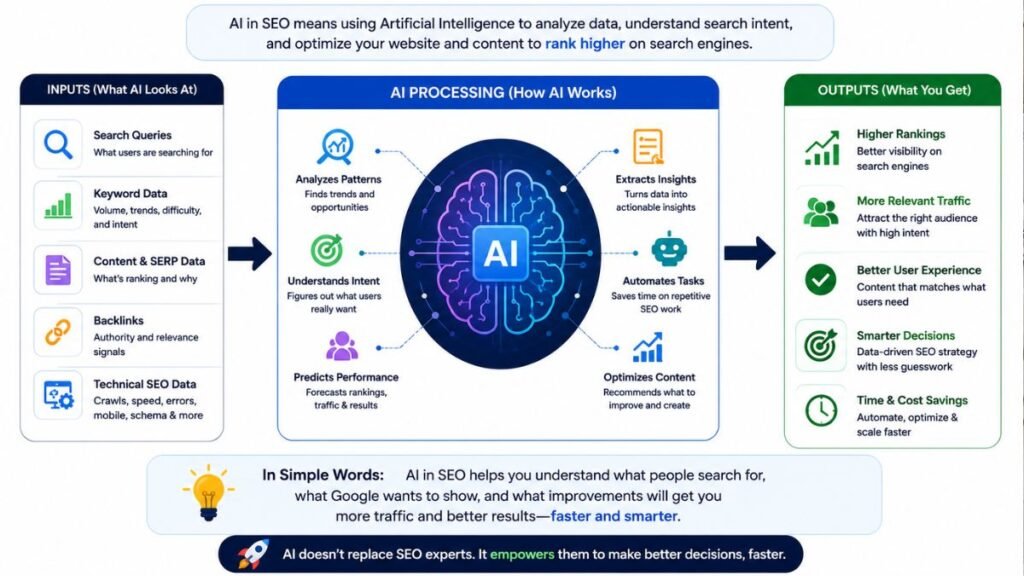
AI for SEO describes using machine learning, natural language processing, and large language models to handle tasks that previously required significant manual effort or specialist expertise that most businesses couldn’t justify hiring for.
In practical terms, this looks like:
- Analyzing thousands of keywords and clustering them by intent in minutes
- Generating detailed content briefs based on what’s currently ranking and why
- Identifying technical issues across large sites automatically
- Drafting meta descriptions, title tag variations, and FAQ structures at volume
- Predicting which pages are at risk of losing rankings before they actually drop
None of this removes the need for strategic thinking. What it does is compress the time between insight (identifying an opportunity) and acting on it, and in competitive digital marketing, that compression matters.
AI in SEO for Keyword Research: From Volume to Search Intent
The old model of keyword research was about volume and competition. Find a term that enough people search, check if it’s winnable, and write the article.
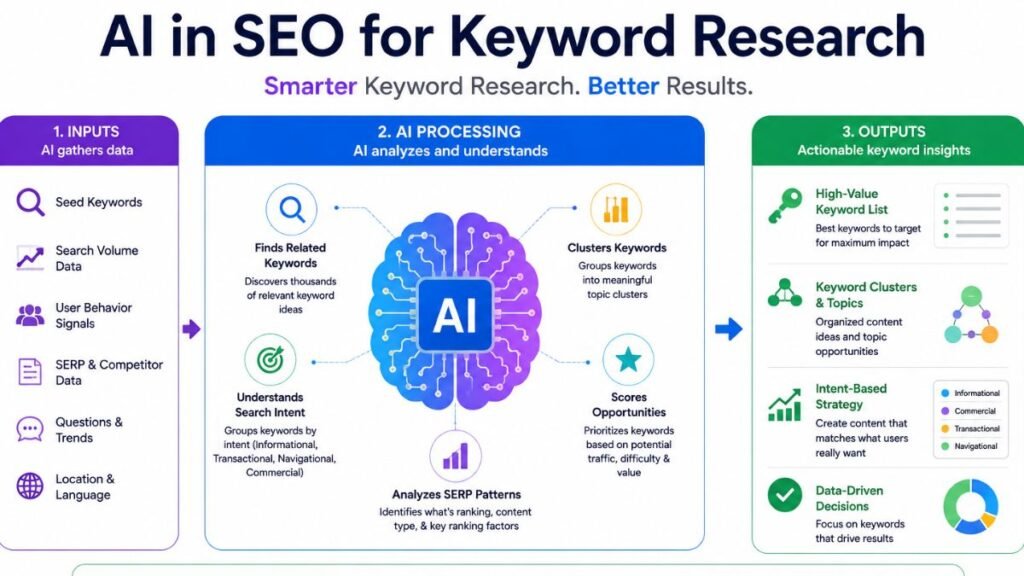
The new model, powered by AI keyword research tools, goes deeper. It groups keywords not just by topic but by intent pattern – transactional, navigational, informational, and investigational. It maps what a user is trying to do, not just what they typed.
Tools running machine learning SEO analysis now surface intent clusters that manual research would miss entirely. A phrase with 200 monthly searches might consistently convert better than a phrase with 2,000, because the intent behind it is closer to a purchase decision. AI surfaces those patterns at a scale humans can’t manually replicate.
AI Content Optimization: What Works in 2026
This is where AI in SEO conversations gets complicated – and where a lot of brands get it wrong. AI writing tools are genuinely useful for first drafts, content outlines, meta descriptions, title tag variations, and FAQ generation. AI content optimization has moved content strategy from gut feel to a measurable signal.
Platforms built on natural language processing SEO now score content against what Google’s own systems understand semantically. They identify missing sub-topics, suggest related entities, and flag where content depth falls short relative to what’s ranking. The brief that used to take a strategist half a day to build now takes twenty minutes – and it’s built on live ranking data rather than assumptions.
The important note: This only works well when the human applying it understands the audience. AI optimisation tools tell you what Google currently rewards. They don’t tell you what your specific audience finds genuinely useful, trustworthy, or worth sharing. That gap is where expertise still wins.
Automated SEO in 2026: Scaling Technical SEO with AI
Enterprise SEO teams have always had a scaling problem. Crawling thousands of pages, monitoring Core Web Vitals across device types, catching schema errors, identifying internal linking gaps – doing this manually across a 50,000-page site is not realistic with a lean team.
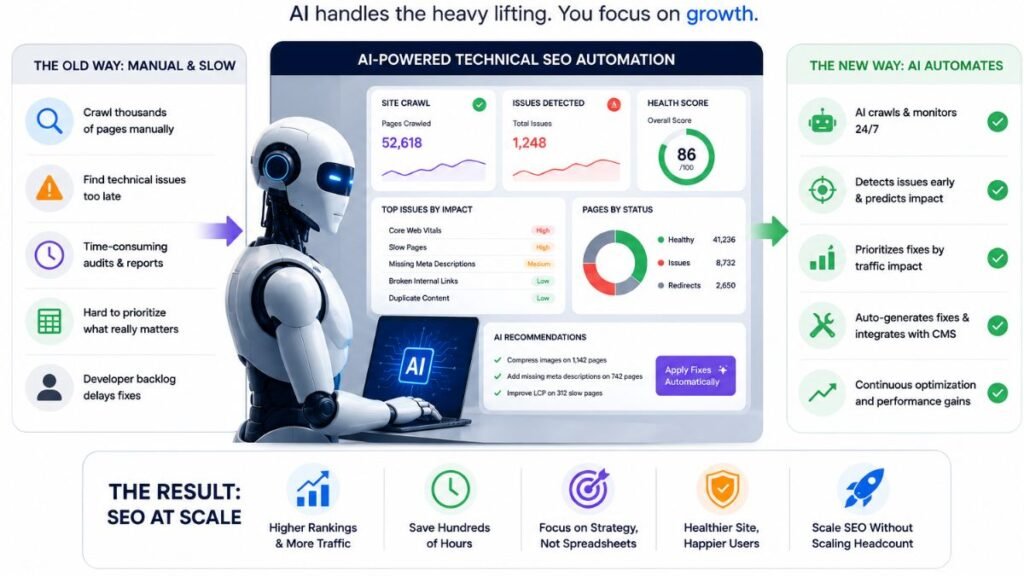
Automated SEO 2026 platforms now do this continuously. They flag issues in priority order, estimate traffic impact, and, in some cases, integrate directly with CMS systems to push fixes without a developer queue. For large sites, this represents a genuine operational shift – not just faster auditing, but proactive issue prevention.
AI Link Building: Faster Prospecting, Smarter Outreach
AI link building hasn’t automated the relationship side of outreach – and it shouldn’t. But it has transformed everything before that point.
AI prospecting tools now analyze competitor backlink profiles, score link opportunities by topical relevance and domain authority simultaneously, identify journalists and bloggers covering adjacent topics, and draft personalized outreach templates based on the prospect’s recent content.
A link-building specialist who used to spend two days on manual prospecting now spends two hours, and the quality of prospects identified is often higher because AI can process more signal variables than a human manually cross-referencing spreadsheets.
SEO With AI: Why Rankings Are Personalized
This is the change that most SEO strategies haven’t fully absorbed yet.
Search intent optimization AI means Google’s systems now factor in user context – device, location, search history, time of day – when deciding which result fits best. Two users typing the same query may see meaningfully different results because Google’s AI infers different needs from their context.
Practically, this means optimizing for a single “target keyword” is less reliable than building content that genuinely serves a specific user scenario with depth and clarity. AI search ranking factors in 2026 weight demonstrated expertise, content freshness, entity authority, and user engagement signals alongside traditional on-page factors.
Best AI SEO tools Worth Using in 2026
Not every tool that slaps “AI” on its homepage deserves that label. These platforms have demonstrated real, measurable utility:
- Surfer SEO – Content optimization and NLP-based scoring. Consistently useful for on-page work and content briefs.
- Semrush AI features – Keyword clustering, content gap analysis, and AI-assisted writing are built into an already-comprehensive SEO suite.
- Ahrefs – Its AI-enhanced keyword intent grouping and content explorer remain industry benchmarks for research and competitive analysis.
- Clearscope – Particularly strong for content teams focused on topical authority building and semantic keyword coverage.
- Screaming Frog + AI integrations – Still the gold standard for technical crawls, now with sharper AI-assisted issue prioritization.
- ChatGPT / Claude for ideation – Useful at the research, structuring, and draft stage. Not a replacement for the editorial process, but a genuine accelerant.
The honest take: Most strong AI SEO tools accelerate execution. They work best when they sit inside a coherent SEO workflow run by people who understand what they’re optimizing for.
Where AI Driven SEO Gets It Wrong (Common Mistakes)
The conversation around AI driven SEO tends toward enthusiasm. The risks deserve equal space.
- Homogenization is a real problem. When every brand in a niche uses the same AI tools for seo to build briefs from the same ranking pages, the content output starts converging. The topics are identical, the structure is identical, and the sub-headings are near-identical. Google’s systems notice. More importantly, readers notice – and they leave.
- Accuracy failure in sensitive categories is costly. In health, finance, legal, and other YMYL niches, unreviewed AI-generated content carries genuine brand risk. Not just ranking risk – reputational risk. A factual error in a medical post doesn’t just fail to rank. It erodes trust that took years to build.
- Over-automation creates fragility. Sites that automate too much of their SEO workflow without human oversight tend to be the same sites that get caught flat-footed by algorithm updates – because no AI tool anticipated the update, and no human was watching closely enough to catch the early signals.
SEO with AI works best as a partnership. The answer isn’t to avoid AI for SEO. It’s to use it with clear guardrails and a strong editorial layer.
SEO with AI: What Actually Works in 2026
The strategies producing sustainable results in 2026 share a consistent pattern. Here’s what’s actually working in 2026:
- Lead with expertise, use AI for efficiency. Let AI handle keyword clustering, brief generation, first drafts, and technical monitoring. Keep human expertise at the centre of strategy, editorial decisions, and anything requiring genuine subject matter depth.
- Prioritize topical authority over individual pages. Google’s AI systems evaluate sites holistically. Building comprehensive, interconnected content around a topic cluster consistently outperforms chasing individual keyword rankings with isolated pages.
- Optimize for SGE visibility. Structure content to answer specific questions directly and clearly. Concise, well-sourced answers in a logical format are what gets surfaced in AI-generated search summaries.
- Audit your AI-generated content rigorously. Before publishing, every piece needs a human pass for accuracy, brand voice, and genuine usefulness. Speed without quality is the fastest way to a Helpful Content penalty.
- Watch your traffic sources, not just rankings. In an SGE-heavy environment, ranking position and actual clicks have diverged for many query types. Measure what’s actually driving sessions, not just where you appear.
Google AI Search Updates and SGE: What It Means for Traffic
Track clicks, not just rankings. Google SGE’s impact on traffic has decoupled rankings and clicks on many query types. A position-three ranking that earns 800 clicks per month is more valuable than a position-one ranking that earns 200. Attribution matters more now, not less.
Google AI search updates require faster adaptation. The update cycle is shorter than it was. Sites that monitor traffic patterns weekly – not monthly – catch early signals of algorithmic shifts before they become crises.
FAQs – AI in SEO 2026
No AI in SEO is not replacing human SEO professionals, but restructuring the process. The work that AI handles well is repetitive, data-intensive, and pattern-based: keyword clustering, technical monitoring, content scoring, and meta generation. The work that remains human is everything that requires strategic judgment, real expertise, audience understanding, and relationship-building. SEO professionals who’ve adapted to SEO with AI as a workflow are outperforming those who’ve ignored it or those who’ve handed everything over to automation.
Google’s position is that content quality matters, not content origin. AI-generated content that’s accurate, editorially reviewed, and genuinely useful can rank. AI-generated content that’s bulk-produced, unedited, and exists primarily to fill keyword gaps consistently underperforms – not because it’s AI-generated, but because it’s low quality. The editorial layer is what separates the two.
Surfer SEO for content optimization, Semrush and Ahrefs for research and competitive intelligence, Clearscope for topical authority, and Screaming Frog for technical audits represent the current reliable tier. For AI content optimization and brief generation, these AI tools for SEO outperform generic AI writing tools because they’re built specifically on SEO signal data.
Google SGE’s impact on traffic has been most pronounced on informational, top-of-funnel queries – how-to content, definitions, and general research questions. Transactional and commercial queries are less affected because users still click through to evaluate and purchase. The strategic response is shifting content investment toward higher-intent topics where clicks still happen.
AI driven SEO in practice means AI tools handle data gathering, pattern identification, content scoring, technical monitoring, and outreach prospecting – while humans handle strategy direction, editorial quality, creative differentiation, and relationship-based link acquisition. It’s a division of labour based on what each does well, not a wholesale handoff.
Yes, and this is one of the genuinely democratising aspects of AI for SEO. Capabilities that previously required agency retainers or large in-house teams are now accessible at SMB price points. A small business owner with Surfer and Semrush has access to artificial intelligence search optimization analysis that would have been enterprise-only spending three years ago. The tool access gap has narrowed substantially.
Three principles hold regardless of how Google’s AI evolves: demonstrate genuine expertise on your topics, build comprehensive topical coverage rather than isolated pages, and keep your technical foundation clean. These align with what users actually value – and Google’s AI, however it develops, is ultimately trying to surface what users value. Optimize for the user first; the algorithm follows.
Last Updated on: September 25, 2026
Leave A Comment